Showing posts with label Godzilla. Show all posts
Showing posts with label Godzilla. Show all posts
Tuesday, July 15, 2014


Thursday, February 20, 2014

Saturday, July 20, 2013
G-FEST XX: Gone Too Soon
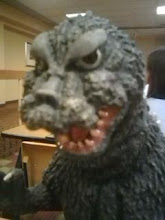
One week ago, G-FEST was in full swing--actually, it was more than half over. Godzilla vs. Megaguirus was just beginning to screen. We had decided to stay in and watch the latest Ultraman movie on "G-TV." It had been a briskly paced, adrenaline-fueled day, as G-FEST days generally are. Those who were there are already looking back wistfully at the twentieth Godzilla get-together--and looking forward to the next. Over the next several weeks we will share our memories with you of our family's fifth journey to the heart of kaiju fandom. It more than lived up to expectations--it's not every day you get to shake hands with Godzilla, after all!

Tuesday, July 2, 2013

Thursday, June 20, 2013
G-FEST Junior: A Look Back
This heretofore unpublished article looks back at last year's G-FEST Kid's Thread. This year's thread will have nearly three times as many offerings for young participants!
 G-FEST is an event that nurtures the child in each participant; at the
same time, a growing number of the participants are actually still children.
With that in mind, G-FEST XIX featured coursework aimed right at our youngest
students. The half hour sessions informed and entertained kaiju kids and their
families in a classroom filled to capacity.
G-FEST is an event that nurtures the child in each participant; at the
same time, a growing number of the participants are actually still children.
With that in mind, G-FEST XIX featured coursework aimed right at our youngest
students. The half hour sessions informed and entertained kaiju kids and their
families in a classroom filled to capacity.
First up, the Dean of Kaiju U., J.D. Lees, gave a crash course in Japanese language, with an emphasis on monster nomenclature. Students spoke the names of their favorite creatures, and Mr. Lees explained their Japanese roots. One fact that delighted the class was the revelation that "Hedorah" can mean "to vomit." It was an enlightening way to start the school day.
Next, Tom Tvrdik, whose work has repeatedly graced the pages of G-FAN, delighted each aspiring artist with the gift of a Far East Monsters coloring poster and turned them loose. The Crowne Plaza's Haneda room became a makeshift studio, as kids and parents alike unleashed their creativity. Mr. Tvrdik actively shared tips for coloring and shading, but also let each artist experiment for him or herself. His generosity made for a very memorable session.

 Finally, associate professor of kaiju history Mark Matzke provided the
ambitious "Diary of a Kaiju: All of Godzilla's Films in Thirty
Minutes." Accompanied by a slide for each movie, Mr. Matzke filled the air
with fun facts about the entire Godzilla series, only occasionally stopping to
breathe. Students had the chance to remember favorite flicks or look for new
movies to view.
Finally, associate professor of kaiju history Mark Matzke provided the
ambitious "Diary of a Kaiju: All of Godzilla's Films in Thirty
Minutes." Accompanied by a slide for each movie, Mr. Matzke filled the air
with fun facts about the entire Godzilla series, only occasionally stopping to
breathe. Students had the chance to remember favorite flicks or look for new
movies to view.
 Then, all too quickly, school was out. Nevertheless, it was great to
witness the proficiency and enthusiasm of the students in attendance. Many
thanks to the faculty of Kaiju University for sharing their expertise with a
new generation of G-Fans!
Then, all too quickly, school was out. Nevertheless, it was great to
witness the proficiency and enthusiasm of the students in attendance. Many
thanks to the faculty of Kaiju University for sharing their expertise with a
new generation of G-Fans!

First up, the Dean of Kaiju U., J.D. Lees, gave a crash course in Japanese language, with an emphasis on monster nomenclature. Students spoke the names of their favorite creatures, and Mr. Lees explained their Japanese roots. One fact that delighted the class was the revelation that "Hedorah" can mean "to vomit." It was an enlightening way to start the school day.
Next, Tom Tvrdik, whose work has repeatedly graced the pages of G-FAN, delighted each aspiring artist with the gift of a Far East Monsters coloring poster and turned them loose. The Crowne Plaza's Haneda room became a makeshift studio, as kids and parents alike unleashed their creativity. Mr. Tvrdik actively shared tips for coloring and shading, but also let each artist experiment for him or herself. His generosity made for a very memorable session.

Doctor of Ultraman Studies Tim Bean began his presentation with many
students still engaged in activity, but he quickly commanded attention with a
video presentation of Ultraman toys. The classroom was soon transfixed by
images from Japan's Bandai Museum and Mr. Bean's own extensive collection. The
discussion took an even more interactive turn when he produced an authentic
Beta Capsule and ray pistol. The questions and answers were flying--our
instructor successfully fanned the flame of interest in Ultra collecting!


Monday, September 13, 2010
Godzillapalooza at Spaceman Floyd's

The exceptional model-making skills of Matt Evangelista are currently featured in a one-of-a-kind display at Spaceman Floyd's Cosmic Toys, 46 West Main Street, Madison, Ohio. One doubts that a kaiju exhibit of this caliber has ever been staged in North America outside of a G-FEST. Godzilla and "garage kit" model enthusiasts within driving distance of northeast Ohio are strongly urged to make the trip to Madison's new vintage toy store to see these phenomenal figures.
 As you can see, Andy was invited to participate in setting up the display, to the extent that Geneva's Kaiju Modeler gave Andy creative control of the location and position of the monstrous models. Andy especially enjoyed putting each individual bomb on Mechanikong's belt. Stretching the boundaries of credulity, this was the second display that he was involved in setting up that day--the first was a case we arranged for Spaceman Floyd's at the Perry Public Library!
Take advantage of this opportunity if you are able--you will not be disappointed. It is far more likely you will be astounded and delighted. But do not delay--a Christmas-themed window will likely appear in mid-to-late November, so catch the kaiju while you can!
Spaceman Floyd's Cosmic Toys is open Monday--Saturday, noon to eight.
 Andy, Matt, and Jason survey a job well done--come check it out!
 Andy, Matt, and Jason survey a job well done--come check it out!
 Monday, September 6, 2010
Retro Reprint: Wonderland Records "Godzilla: King of the Monsters"
Seeing as how G-FAN # 91 is now sold out, I thought I would post this brief article, which appeared in its pages. It was great fun going back and listening to this album, and I hope that translates into the writing...
 “Godzilla! A prehistoric monster, born in the modern world. Some say a friend; some say foe; and where will he surface next?”
So begins the story “Godzilla vs. Amphibion,” which, along with “Godzilla vs. the Alien Invasion,” comprises the Wonderland Records L.P. “Godzilla: King of the Monsters.” Produced by Cinema Sound, Ltd. and featuring Herb Trimpe’s artwork on the cover, this record epitomizes the standing that Godzilla had come to occupy in American popular culture in the late 1970’s. It was also a foundational part of my early G-fandom (I was five years old at the time of its release), so I approach this recording not with ironic detachment towards some kitschy pop artifact, but with the goodwill and good humor one reserves for the souvenirs of his childhood. Dropping the needle on the Godzilla L.P. is as close to time travel as I will ever get. Travel with me for a few moments back to the late 70’s, a wondrous era for the young imagination—an era populated by droids, interstellar battles, Bigfoot sightings, and a radioactive monster named Godzilla.
SIDE A—Godzilla vs. Amphibion
Our story begins with one Mr. Bishop and the captain of a fishing vessel witnessing Godzilla’s pursuit of Amphibion through the waters of the Bermuda Triangle. At the Miami Marina bar, the unlucky duo tries to process what they have seen. The boat’s captain urges silence (and booze) upon a rattled Bishop, but he seems adamant about reporting the sighting to the proper authorities.
Not too much later, Captain Rick Thompson is taking his son Tommy on a distance run in a fighter jet over the Bermuda Triangle. Spotting an unusual disturbance in the waters below, they swoop down to take photographs.
Captain Thompson and Tommy take the developed photos to Larry Jennings, a “trained paleontologist.” After initially being dismissive, Jennings identifies the creature in the photos as “the next best thing to the Loch Ness Monster”—Godzilla! In Jennings’ considered opinion, Godzilla is a long dormant plesiosaur awakened by nuclear radiation.
After receiving a report from a commercial airline pilot about two giant creatures approaching Miami Beach, Commander Radley orders Captain Thompson to scramble nuclear fighter jets to stop the monsters. Jennings, an apparent stickler for “accuracy,” corrects Commander Radley by insisting that Godzilla be referred to as a plesiosaur. Thirty years ahead of his time, Commander Radley responds with an impatient “Whatever, Jennings.”
Just before take-off, Jennings advises Thompson to avoid killing Godzilla, as he seems to be trying to defend Florida from attack. Thompson pledges to try.
Two surfers, Bill and Shorty, are catching the “five-footers” off Miami Beach, when Bill gets a little foolhardy and perishes beneath the giant fin of Amphibion. Amphibion’s roar is heard for the first time, emitting a guttural growl that sounds curiously like a gentle Chewbacca.
Jennings, Tommy and Captain Wilson watch in amazement as Godzilla chases Amphibion onto the beach, and we get our most complete description of Godzilla’s foe, which includes a one-hundred foot fin, claws like a giant lobster, and a radioactive glow. Captain Wilson gives the order for his men to “fire at will,” and heavy artillery begins to pound the creatures. Godzilla bellows his distinctive roar, and Jennings implores Captain Wilson not to target the King of the Monsters.
Thompson leads a bombing run, nuclear warheads at the ready, but they prove unnecessary. Godzilla makes short work of Amphibion, snapping the sea creature’s neck like a celery stalk.
While taking pictures of the fallen monster, Jennings arranges for Amphibion’s carcass to be taken back to the military base for study, radiation evidently no longer a concern.
Captain Thompson gives orders for his squadron to return to base, letting Godzilla return to the ocean depths. As he streaks home, he says, “Well done, Godzilla, old boy.” Godzilla sounds his good-bye.
SIDE B—Godzilla vs. the Alien Invasion
Two sailors on a timber barge in the northern part of Lake Michigan watch in terror as Godzilla surfaces and heads in a southwesterly direction towards the Wisconsin shoreline. The monster’s radioactivity kills their radio, so they have no way of communicating what they have seen. The narrator assuages our concern at these developments by saying “Obviously, these sailors don’t realize that Godzilla is friendly toward mankind.” Whew!
Next, we are taken inside an alien spacecraft hovering one hundred miles north of Chicago. Commander Bruton expresses condescending amusement at the earth name “Mich-i-gan.” The craft lands and his assistants Talem and Lonar plant alien birth pods in the cool lake water.
Meanwhile, two college students, Billy and Linda, have been commissioned by Dr. Scott to head to Port Washington, Wisconsin, to investigate a rash of U.F.O. sightings in the area. Immediately upon arriving at the scene, they spot the extraterrestrial saucer in flight. As if that weren’t enough excitement, a couple of two-hundred-foot-tall slimy green creatures burst out of the water, with sparks shooting out of their arms and red eyeballs aflame. Seconds later, Godzilla surfaces as well, prompting Billy to declare, “If that’s not a prehistoric lizard, I—I don’t know what!” After easily dispatching with the aliens, Godzilla heads south. Billy estimates him to be four hundred feet tall.
Aboard their interstellar vehicle, the aliens learn that two of their birth pods have hatched prematurely, causing Commander Bruton to adjust his plan. He decides the time is right to unleash their full-scale invasion of earth.
Billy and Linda return to show Dr. Scott their incredible photographs, and the professor confidently labels Godzilla a “two legged plesiosaur.” Intrigued as only a U.F.O researching coed can be, Linda asks, “Where did Godzilla come from—originally?” Dr. Scott replies, “Godzilla is an ancestral Tyrannosaurus Rex” who had been “jostled to radioactive life from a long-dormant state in the Sea of Japan.” Dr. Scott continues, “He’s a friendly creature, really, he’s just too big for the modern world.” This elicits a moment of sympathy from Linda, who then cheerfully labels the alien mutants “overgrown string beans—except for their big red eyes!” Dr. Scott, standing among his bubbling test tubes, resolves to contact the authorities to prevent Godzilla from being attacked.
Twenty of the pods hatch, and together with an alien fleet of ships, the invasion abruptly begins. Fighter jets engage the saucers, while Godzilla makes quick work of the “overgrown string beans.” In a matter of seconds, the invasion is thwarted. Godzilla roars in triumph.
Dr. Scott arranges for an alien mutant’s carcass to be taken back to his laboratory for study (he and Larry Jennings from Side A must have received the same post-monster-attack training). Linda shouts “Thanks Godzilla!” as the Big Guy disappears into the waters of Lake Michigan.
These briskly paced episodes are undeniably fun, and I am fond of them largely for nostalgic reasons. But the truth is Godzilla isn’t given much to do in either tale. His original roar is used liberally throughout both stories, but the fights are perfunctory, and are resolved more quickly than the battles in Godzilla: Final Wars. In the case of the alien invasion, Godzilla handles the situation in less than ten seconds. That isn’t much in the way of a payoff for the listener. Godzilla’s origins are treated in a dubious fashion, as well. The pseudo-paleontology the “experts” spout is nonsensical, and Godzilla’s true beginning is glossed over, in part to protect his reputation as a “friendly creature.” In both narratives, Godzilla’s character (undeveloped as it is) is a direct reflection of the 70’s Toho films that cast him as a defender of Earth. The writers and producers were working on the assumption that Godzilla is kindly disposed towards humankind—a sign of the times, certainly, and a kid-friendly approach that spawned many fans.
Taken on its own merits, this recording provides a fascinating mash-up of 70’s sensibilities. One can sense the influence of Charles Berlitz’s Bermuda Triangle books; popular writing about the Loch Ness Monster; public fascination with U.F.O.s, which reached new heights in the 70’s with movies like Close Encounters of the Third Kind and countless dime-store paperbacks on the subject, (such as Erich Von Daniken’s “Chariots of the Gods”); Steven Spielberg’s Jaws is referenced in passing; and even such low-budget movies as The Creature From Black Lake in which a college professor sends students out to look for cryptids, may have factored in somehow. Just add Godzilla to the mix and you have a trippy time capsule, evocative of an era when the bizarre began to go mainstream, all wrapped up in a tasty package for kids like me to digest.
In 1998, Golden Drive Records re-released this recording on C.D., with the addition of two club-style dance cuts. One incorporates dialogue from Amphibion and Alien Invasion; the other loosely marries Ifukube themes to a thumping drum track (yet another sign of the times, for better or for worse). Although it is nice to have this recording in an easy-to-use format for road trips and the like, nothing beats putting the vinyl on the turntable and letting those childhood flights of fancy come flooding back, all starring Godzilla, undisputed King of the Monsters.
 “Godzilla! A prehistoric monster, born in the modern world. Some say a friend; some say foe; and where will he surface next?”
So begins the story “Godzilla vs. Amphibion,” which, along with “Godzilla vs. the Alien Invasion,” comprises the Wonderland Records L.P. “Godzilla: King of the Monsters.” Produced by Cinema Sound, Ltd. and featuring Herb Trimpe’s artwork on the cover, this record epitomizes the standing that Godzilla had come to occupy in American popular culture in the late 1970’s. It was also a foundational part of my early G-fandom (I was five years old at the time of its release), so I approach this recording not with ironic detachment towards some kitschy pop artifact, but with the goodwill and good humor one reserves for the souvenirs of his childhood. Dropping the needle on the Godzilla L.P. is as close to time travel as I will ever get. Travel with me for a few moments back to the late 70’s, a wondrous era for the young imagination—an era populated by droids, interstellar battles, Bigfoot sightings, and a radioactive monster named Godzilla.
SIDE A—Godzilla vs. Amphibion
Our story begins with one Mr. Bishop and the captain of a fishing vessel witnessing Godzilla’s pursuit of Amphibion through the waters of the Bermuda Triangle. At the Miami Marina bar, the unlucky duo tries to process what they have seen. The boat’s captain urges silence (and booze) upon a rattled Bishop, but he seems adamant about reporting the sighting to the proper authorities.
Not too much later, Captain Rick Thompson is taking his son Tommy on a distance run in a fighter jet over the Bermuda Triangle. Spotting an unusual disturbance in the waters below, they swoop down to take photographs.
Captain Thompson and Tommy take the developed photos to Larry Jennings, a “trained paleontologist.” After initially being dismissive, Jennings identifies the creature in the photos as “the next best thing to the Loch Ness Monster”—Godzilla! In Jennings’ considered opinion, Godzilla is a long dormant plesiosaur awakened by nuclear radiation.
After receiving a report from a commercial airline pilot about two giant creatures approaching Miami Beach, Commander Radley orders Captain Thompson to scramble nuclear fighter jets to stop the monsters. Jennings, an apparent stickler for “accuracy,” corrects Commander Radley by insisting that Godzilla be referred to as a plesiosaur. Thirty years ahead of his time, Commander Radley responds with an impatient “Whatever, Jennings.”
Just before take-off, Jennings advises Thompson to avoid killing Godzilla, as he seems to be trying to defend Florida from attack. Thompson pledges to try.
Two surfers, Bill and Shorty, are catching the “five-footers” off Miami Beach, when Bill gets a little foolhardy and perishes beneath the giant fin of Amphibion. Amphibion’s roar is heard for the first time, emitting a guttural growl that sounds curiously like a gentle Chewbacca.
Jennings, Tommy and Captain Wilson watch in amazement as Godzilla chases Amphibion onto the beach, and we get our most complete description of Godzilla’s foe, which includes a one-hundred foot fin, claws like a giant lobster, and a radioactive glow. Captain Wilson gives the order for his men to “fire at will,” and heavy artillery begins to pound the creatures. Godzilla bellows his distinctive roar, and Jennings implores Captain Wilson not to target the King of the Monsters.
Thompson leads a bombing run, nuclear warheads at the ready, but they prove unnecessary. Godzilla makes short work of Amphibion, snapping the sea creature’s neck like a celery stalk.
While taking pictures of the fallen monster, Jennings arranges for Amphibion’s carcass to be taken back to the military base for study, radiation evidently no longer a concern.
Captain Thompson gives orders for his squadron to return to base, letting Godzilla return to the ocean depths. As he streaks home, he says, “Well done, Godzilla, old boy.” Godzilla sounds his good-bye.
SIDE B—Godzilla vs. the Alien Invasion
Two sailors on a timber barge in the northern part of Lake Michigan watch in terror as Godzilla surfaces and heads in a southwesterly direction towards the Wisconsin shoreline. The monster’s radioactivity kills their radio, so they have no way of communicating what they have seen. The narrator assuages our concern at these developments by saying “Obviously, these sailors don’t realize that Godzilla is friendly toward mankind.” Whew!
Next, we are taken inside an alien spacecraft hovering one hundred miles north of Chicago. Commander Bruton expresses condescending amusement at the earth name “Mich-i-gan.” The craft lands and his assistants Talem and Lonar plant alien birth pods in the cool lake water.
Meanwhile, two college students, Billy and Linda, have been commissioned by Dr. Scott to head to Port Washington, Wisconsin, to investigate a rash of U.F.O. sightings in the area. Immediately upon arriving at the scene, they spot the extraterrestrial saucer in flight. As if that weren’t enough excitement, a couple of two-hundred-foot-tall slimy green creatures burst out of the water, with sparks shooting out of their arms and red eyeballs aflame. Seconds later, Godzilla surfaces as well, prompting Billy to declare, “If that’s not a prehistoric lizard, I—I don’t know what!” After easily dispatching with the aliens, Godzilla heads south. Billy estimates him to be four hundred feet tall.
Aboard their interstellar vehicle, the aliens learn that two of their birth pods have hatched prematurely, causing Commander Bruton to adjust his plan. He decides the time is right to unleash their full-scale invasion of earth.
Billy and Linda return to show Dr. Scott their incredible photographs, and the professor confidently labels Godzilla a “two legged plesiosaur.” Intrigued as only a U.F.O researching coed can be, Linda asks, “Where did Godzilla come from—originally?” Dr. Scott replies, “Godzilla is an ancestral Tyrannosaurus Rex” who had been “jostled to radioactive life from a long-dormant state in the Sea of Japan.” Dr. Scott continues, “He’s a friendly creature, really, he’s just too big for the modern world.” This elicits a moment of sympathy from Linda, who then cheerfully labels the alien mutants “overgrown string beans—except for their big red eyes!” Dr. Scott, standing among his bubbling test tubes, resolves to contact the authorities to prevent Godzilla from being attacked.
Twenty of the pods hatch, and together with an alien fleet of ships, the invasion abruptly begins. Fighter jets engage the saucers, while Godzilla makes quick work of the “overgrown string beans.” In a matter of seconds, the invasion is thwarted. Godzilla roars in triumph.
Dr. Scott arranges for an alien mutant’s carcass to be taken back to his laboratory for study (he and Larry Jennings from Side A must have received the same post-monster-attack training). Linda shouts “Thanks Godzilla!” as the Big Guy disappears into the waters of Lake Michigan.
These briskly paced episodes are undeniably fun, and I am fond of them largely for nostalgic reasons. But the truth is Godzilla isn’t given much to do in either tale. His original roar is used liberally throughout both stories, but the fights are perfunctory, and are resolved more quickly than the battles in Godzilla: Final Wars. In the case of the alien invasion, Godzilla handles the situation in less than ten seconds. That isn’t much in the way of a payoff for the listener. Godzilla’s origins are treated in a dubious fashion, as well. The pseudo-paleontology the “experts” spout is nonsensical, and Godzilla’s true beginning is glossed over, in part to protect his reputation as a “friendly creature.” In both narratives, Godzilla’s character (undeveloped as it is) is a direct reflection of the 70’s Toho films that cast him as a defender of Earth. The writers and producers were working on the assumption that Godzilla is kindly disposed towards humankind—a sign of the times, certainly, and a kid-friendly approach that spawned many fans.
Taken on its own merits, this recording provides a fascinating mash-up of 70’s sensibilities. One can sense the influence of Charles Berlitz’s Bermuda Triangle books; popular writing about the Loch Ness Monster; public fascination with U.F.O.s, which reached new heights in the 70’s with movies like Close Encounters of the Third Kind and countless dime-store paperbacks on the subject, (such as Erich Von Daniken’s “Chariots of the Gods”); Steven Spielberg’s Jaws is referenced in passing; and even such low-budget movies as The Creature From Black Lake in which a college professor sends students out to look for cryptids, may have factored in somehow. Just add Godzilla to the mix and you have a trippy time capsule, evocative of an era when the bizarre began to go mainstream, all wrapped up in a tasty package for kids like me to digest.
In 1998, Golden Drive Records re-released this recording on C.D., with the addition of two club-style dance cuts. One incorporates dialogue from Amphibion and Alien Invasion; the other loosely marries Ifukube themes to a thumping drum track (yet another sign of the times, for better or for worse). Although it is nice to have this recording in an easy-to-use format for road trips and the like, nothing beats putting the vinyl on the turntable and letting those childhood flights of fancy come flooding back, all starring Godzilla, undisputed King of the Monsters.
Subscribe to:
Posts (Atom)